
What a fractional CTO does (and when it is the wrong shape for your agency)
Part-time technical leadership is easy to label and hard to scope. Here is how to read the role before you sign.
If you have spent any time on LinkedIn in the last few years, everyone is fractional something. Fractional CFO, fractional CMO, fractional dog walker. Stick “fractional” in front of a serious job title and it sounds grown-up, like you have a board and a cap table even when you are mostly trying to get a milestone invoice paid on time.
I am not knocking the model. I have seen it work. I have also seen it used as wallpaper over a hole where technical judgement and delivery discipline should sit. This piece is a field guide for agency owners, delivery and project leads, and operators who touch tech decisions even if they do not write code. It is also written from the point of view of a shop that sells on-demand development. I am not here to sell you that. I want the words fractional CTO to mean something concrete before anyone signs anything.
Industry writing and practitioner accounts describe the role in overlapping ways; useful syntheses include marketplaces that match startups to part-time leaders (Connectd), agency-style service descriptions (Storm Consultancy), a long-form practitioner perspective on the career (Pragmatic Engineer), and a sharp breakdown of what the job demands in practice (Gary Worthington on LinkedIn).
Fractional is not interim, and neither is “advisor with a fancy day rate”
Interim CTO usually means someone steps in full time for a fixed chapter: cover a departure, steady the function, maybe hire their replacement. They live in your calendar and your incidents.
Fractional CTO means part-time technical leadership across more than one context (often more than one company), with a relationship that can run for months rather than a two-week rescue. The point is to buy senior judgement without a full-time salary line.
Where it goes wrong is label creep. Some engagements are really short consulting: set up a few accounts, introduce a contractor, vanish. Others are advisory: join the odd investor call, comment on a deck, never touch the repo. A serious fractional CTO can include those tasks. If that is all you get, you do not have leadership; you have a part-time commentator.
The useful definition I borrow from people who do the job properly: a full-time leader in part-time hours. That is not poetry; it is a warning. If your fractional hire cannot slow you down when you are about to waste money, cannot stand next to you when a client or investor asks hard questions, and cannot leave the team with clearer rules than they started with, you bought the wrong thing.
What the work actually looks like
Forget the org chart for a minute. In practice, the job is a bundle of tasks that vary by week:
- Hiring and bar-setting: interviews, trial tasks, “what good looks like” for your stack.
- Architecture and delivery risk: what to build now, what to defer, what not to build at all.
- Code and process quality: review, release discipline, tests, monitoring: the boring stuff that stops Friday nights turning into war rooms.
- Vendors and integrations: sorting signal from sales fluff when a platform promises the moon.
- Security and compliance guidance: sensible defaults and risk talk; not the same as legal advice.
- Investors and due diligence: translating between what engineers know and what a room full of non-coders needs to hear so they stop panicking about the wrong threat.
Cadence can be heavy (a couple of days a week inside the team) or light (a steady rhythm of steer and review). The mistake is optimising for cheap instead of clear: if they are not in the loop when decisions harden, they are not leading; they are commenting from the gallery.
When full-time beats fractional
Full-time starts to make sense when the blast radius of technical decisions is large and constant: a growing product org, always-on operations, regulation touching everything you ship, or a team that needs daily executive cover for prioritisation and politics.
Fractional tends to fit when you need authority and pattern-matching but not every hour of the week: early shape of a system, a messy transition, hiring a permanent lead, or a period where you must professionalise how you build without pretending you are a Series B product company yet.
That trade-off shows up in plain FAQ-style guidance from matching platforms: startups often start fractional for flexibility, then move full-time when the function needs round-the-clock ownership. The same logic applies if you run an agency: client delivery can create spikes that look like a product company one quarter and a shell the next.
The agency twist: same title, different weather
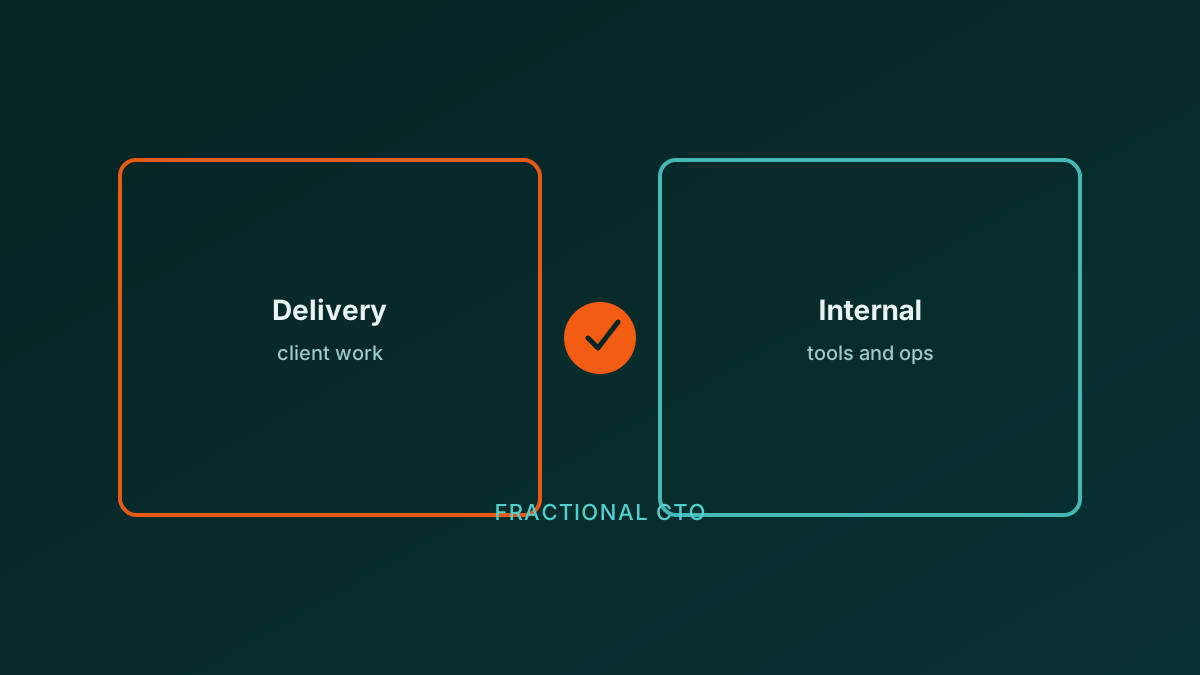
Most “fractional CTO” marketing is written for product startups: roadmap, runway, equity story. Agency life is two-sided. Outward, you have on-off project delivery: margins are thin, deadlines are real, and the “product” is delivery plus trust. Inward, you have internal tooling and operations: the patchwork of Slack, spreadsheets, time tracking, a CMS nobody likes, and the glue nobody bills for until it fails under a client. Both sides need technical attention; the second is easy to starve because it rarely sits on an SOW.
So the CTO-shaped problem mutates. You might not need someone to own a single product vision. You might need:
- Standards that survive handovers between projects.
- Honest estimates when a client brief is fuzzy.
- Someone who can look a subcontractor in the eye and know if they are bluffing.
- A grown-up view on internal automation (yes, including AI) without turning the place into a lab experiment.
The twist versus a product company: there the fractional leader can spend most of their time in one mode (shape the product, harden the stack, speak to investors). In an agency, a fractional CTO has to switch modes deliberately: defend delivery quality and risk under client pressure, then step across to internal systems, data, and process so the place does not run on heroics. If they only live on side one, your back office and glue code rot. If they only live on side two, delivery leads still carry every firefight alone. Good fractional work here names both sides in the brief and protects calendar and authority for each. Fractional leadership and on-demand build still sit on the same spectrum (judgement in slices versus hands on keys), but the purpose of spelling out the two sides is simple: hire and scope for someone who can context-switch without pretending those are the same job on the same day.
How to buy it without getting played
Authority: Can they say no to the founder or the biggest client without you quietly starving the relationship?
Access: Do they see production, incidents, and costs, or only slide decks?
Cadence: Is there a minimum rhythm that survives busy weeks, or do they disappear when you need them?
Definition of done: Are outcomes tied to delivery health (releases, incidents, hiring outcomes), or to attendance?
Red flags: everything is “strategic” but nothing ships safer; you still carry every outage alone; or the engagement reads like theatre: lots of meetings, no change in how code leaves the building.
A composite picture (anonymised)
A mid-sized creative agency (roughly forty people) brought in a “fractional CTO” after a painful client loss traced to weak testing and no clear owner for production issues. The first hire looked good on paper: polished decks, strong network. Six months in, the delivery leads were still the ones firefighting. The fractional hire had opinions about roadmaps but never locked release checks or on-call expectations. The relationship died quietly.
Second attempt: less polish, more dirt under the nails. Smaller time commitment, but fixed weekly touchpoints with leads, written standards for releases, and explicit rules for when the agency paused new feature work to fix foundations. No magic: just judgement plus follow-through. That is the difference between buying a title and buying technical gravity.
Details are composite and anonymised; they are meant to illustrate a pattern, not to represent a single client.
Takeaways
- Fractional means split time and sustained judgement, not “cheap CTO.” Interim means full-time for a chapter. Do not mix them up when you write the brief.
- If nobody can stop bad build decisions, you do not have leadership. You have a commentator with a calendar invite.
- Agencies: your CTO-shaped problem is often standards, risk, and honesty across projects, not a single hero roadmap. Buy for that weather.
- On-demand engineering and fractional leadership often belong in the same story as different slices of the same job. Split the work honestly instead of inflating a title until it pops.
Further reading
- Connectd: Fractional CTO services (startup-oriented framing and FAQ)
- Pragmatic Engineer: Becoming a Fractional CTO (practitioner career piece; subscription may apply)
- Storm Consultancy: Fractional CTO (example scope menu from an agency context)
- Gary Worthington: What it really takes to be a fractional CTO (role definition, audiences, and craft)
About the author
[Author bio (to be completed for publish: two or three sentences). Include name, role at Actually Tech, and relevant credentials or experience (e.g. live events, software delivery, AI governance). Purpose: E-E-A-T and attribution in search and AI summaries.]
Technical judgement for delivery businesses
If you want to talk shop about how agencies harden delivery and internal ops, we are happy to chat. No obligation.
Book a consultation